Diablillos is a 7,919 ha (79 km2) property located in the Argentine Puna region, which is the southern extension of the Altiplano of southern Peru, Bolivia, and northern Chile. It is a high plateau, separating the Cordillera Oriental to the east from the Andean Cordillera (Cordillera Occidental) to the west.
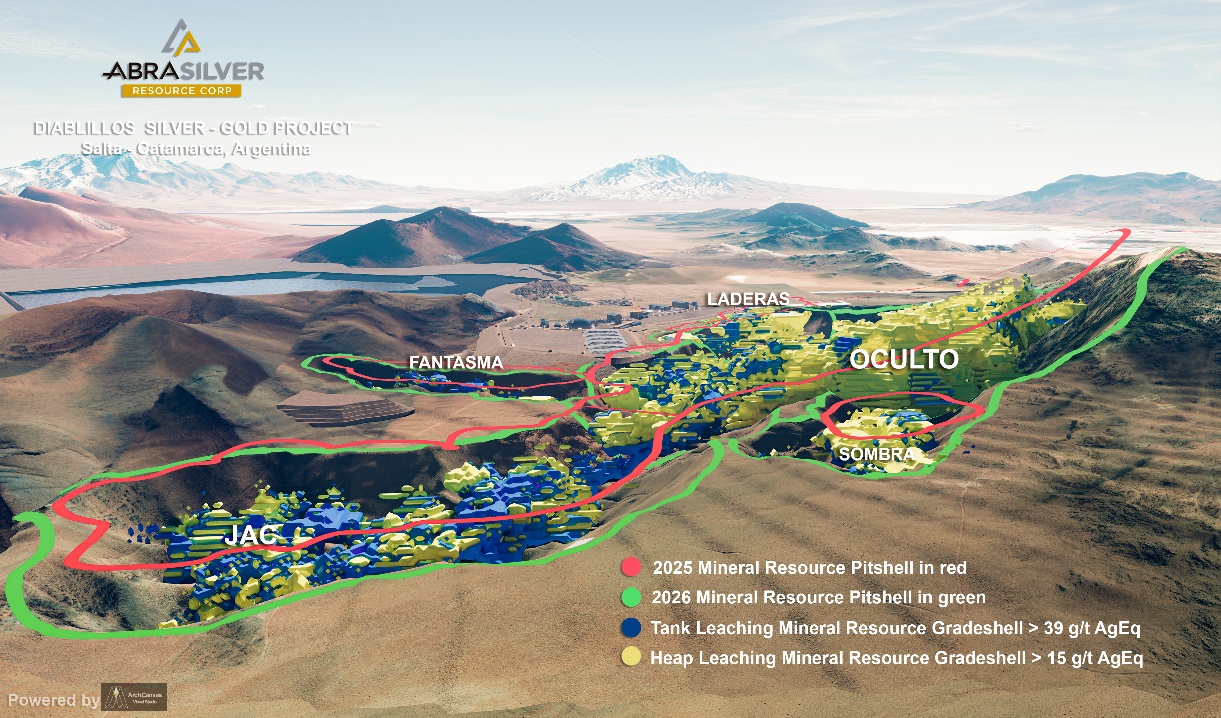
There are currently multiple near-surface deposits on the Diablillos property, including Oculto, JAC, Fantasma and Laderas. Diablillos is a high-sulphidation epithermal silver-gold deposit derived from remnant hot springs activity following Tertiary-age local magmatic and volcanic activity with strong supergene overprinting.
Definitive Feasibility Study completed in June 2026, with CAD$4.2 Billion After-Tax NPV5% and 42% IRR
Scroll right to view more
Scroll right to view more
Scroll right to view more
Scroll right to view more
On June 22, 2026 the Company announced the results of its Definitive Feasibility Study (“DFS” or the “Study”) for the Diablillos silver-gold project.
The DFS was led by Worley and supported by specialist consultants BMining, Envis and INSA. All dollar ($) figures are presented in US dollars unless otherwise stated. Base case metal prices used in the DFS financial analysis were: $50.00/oz silver (“Ag”) and $3,650/oz gold (“Au”).
DFS Study Highlights:
After-tax NPV5% of $3.0 billion (CAD$ 4.2 billion), 41.9% IRR and 1.7-year payback at base-case metal prices.
At spot prices1, after-tax NPV5% increases to $4.8 billion (CAD$6.7 billion) with an IRR of 56.5% and payback of 1.4 years.
Average annual production of 20 Moz silver equivalent (“AgEq”) during the first five years of full mine production, comprised of 14 Moz Ag and 89 koz Au;
Average life-of-mine (“LOM”) annual production of 10 Moz AgEq, comprised of 5.9 Moz Ag and 62 koz Au over a 25-year life of mine (“LOM”).
Low All-in Sustaining Cash Costs (“AISC”)2 of $20/oz AgEq over the LOM – positioning Diablillos among the lowest-cost primary silver projects globally.
Initial capital expenditures of $722 million (including $98 million contingency) with subsequent sustaining capital of $520 million funded through operating cash flow.
Compelling after-tax NPV-to-Capex ratio of 4.2x, highlighting the Project’s robust project economics and strong value generation potential.
Increased Proven and Probable Mineral Reserves of 77.9 Mt grading 146 g/t Ag Eq, containing 183 Moz Ag and 1.8 Moz Au (366 Moz AgEq), estimated from an open pit optimized using metal prices of $29.50/oz Ag and $2,800/oz Au.
First production targeted before year-end 2029, subject to a final investment decision (“FID”) expected in Q2 2027.
Multiple opportunities exist to further enhance Project value beyond the DFS, including:
A Phase 2 heap leach expansion to process lower grade mineralized material that would provide incremental gold and silver production, with results from a Preliminary Economic Assessment (the “Heap Leach PEA”) expected in Q4/2026.
Potential future plant throughput expansion to increase annual silver and gold production; and
Continued exploration success across the broader Diablillos district
Enhanced TSF incorporates a downstream waste rock buttress design, to eliminate credible failure risk while reducing haulage costs and dust generation.
Grid power connection planned in Year 3, reducing both operating costs and carbon emissions.
Project Economics
The table below presents the DFS economics across a range of metal price scenarios. The economics of Diablillos are robust across all scenarios, with an after-tax NPV5%of CAD$6.7 billion and an IRR of 56.5% at recent spot silver and gold prices.
Commodity Price Sensitivity Analysis
Economic Parameters
Base Case
Prices
Recent Spot
Prices1
Base Case
Prices + 20%
Base Case
Prices - 20%
Silver Price ($/oz)
$50.00
$70.69
$60.00
$40.00
Gold Price ($/oz)
$3,650
$4,338
$4,380
$2,920
After-tax NPV (5%, USD$ / CAD$ million)
$3,003 / $4,204
$4,799 / $6,719
$4,116 / $5,763
$1,884 / $2,638
After-tax NPV (8%, USD$ / CAD$ million)
$2,223 / $3,112
$3,623 / $5,072
$3,083 / $4,316
$1,359 / $1,903
After-Tax IRR (%)
41.9%
56.5%
50.9%
31.4%
Payback (years)
1.7
1.4
1.4
2.2
After-Tax NPV5% to Initial Capex Ratio (x)
4.2
6.6
5.7
2.6
1Note: Spot Price as at close on June 15th, 2026, per https://www.lbma.org.uk/ USD:CAD F/X rate: 1.40
Production Summary
The DFS comprises a conventional open-pit mining operation with a strip ratio of 5.9 feeding a 9,000 tpd tank leach processing plant. An optimized mine plan has been developed that prioritizes higher-grade silver and gold mineralization during the early years of production, maximizing early cash flow and accelerating payback. Lower grade material is stockpiled and processed later in the mine life.
The DFS mine plan is based on an updated Mineral Reserve estimate developed from the Mineral Resource estimate reported by the Company on May 6, 2026. The Mineral Reserve estimate was based on an optimized open pit using the latest operating cost, open pit slope, metallurgical recovery assumptions and conservative metal prices of $29.50/oz silver and $2,800/oz gold.
Over the 25-year mine life, Diablillos is expected to produce an average of 10.3 Moz AgEq annually, including 20.3 Moz AgEq per year during the first five years of full production. The robust early production profile reflects both the high-grade nature of the deposit and a mine plan specifically designed to maximize early cash flow and project returns.
The feed to the process plant for the first 17 years of the current mine plan is from higher grade run-of-mine mineralisation while lower grade material is stockpiled. From year 18 onwards, the process plant treats stockpiled mineralisation although the Company recognizes that a potential heap leach operation and/or plant capacity expansion will allow for greater metal production and increased value.
The DFS is supported by extensive metallurgical test work that projects average LOM recoveries of approximately 80.3% for silver and 87.2% for gold.
Table 2 – Grade and Production Profile
Units
Avg. First 5 Years Full Production
Avg. LOM (Year 1 – 24)
Silver Grades
(g/t)
177 g/t
73 g/t
Gold Grades
(g/t)
1.04 g/t
0.70 g/t
Silver-Equivalent Grades
(g/t)
260 g/t
129 g/t
Silver Production
(M oz)
13.9
5.9
Gold Production
(k oz)
89
62
AgEq Production
(M oz)
20.3
10.3
Note: The formula for calculating AgEq is as follows: Silver Eq Oz = Silver Oz + Gold Oz x (Gold Price/Silver Price) x (Gold Recovery/Silver Recovery).
Operating Costs
The operating cost estimates are based on mining contractor rates for truck and shovel mining operation during pre-stripping activities and the first two years of production, transitioning to an owner-operated fleet by the third year. Costs for the operation of the processing plant, TSF and infrastructure are based on first principles estimates for all major cost inputs and consider the cost of diesel generators for power supply until the third year of operation, at which time a connection to the lower cost national grid is anticipated.
The DFS operating cost estimates are shown on a per tonne milled basis in Table 3. The AISC averages $19.89/oz AgEq over the LOM. This positions Diablillos among the lowest-cost primary silver projects globally, underpinning strong operating margins across commodity price cycles.
Table 3 – Mine Operating Cost Estimates
Operating Costs
Basis
Avg. LOM ($)
Mining (ore and waste)
per tonne milled
17.20
Processing Plant, Utilities and Maintenance
per tonne milled
29.01
G&A and Other
per tonne milled
6.20
Total Operating Cost
per tonne milled
52.41
Project Capital Costs
The initial pre-production capital expenditures for the Project as at Final Investment Decision (“FID”) are summarized in Table 4. Capital expenditures to be incurred after the start-up of operations are assigned to sustaining capital and projected to be funded by operating cash flows. Initial capital costs are estimated at $722 million and total sustaining capital costs at $520 million over the LOM. The estimate includes a contingency of $98 million representing the outcome of a quantitative risk analysis of all major cost inputs. Over 60% of equipment, supplies, construction, and service procurement packages will be sourced from local companies and will comply with all local regulations.
Compared with the prior Pre-Feasibility Study, the increase in initial capital reflects engineering advancement, expanded project scope, updated contractor pricing, inflationary impacts and enhanced contingency provisions consistent with a DFS-level study.
Table 4 – Summary of Capital Cost Estimates
Description
DFS Study
$ millions
Surface Mining
$7.6
Process Plant
$229.3
Site Infrastructure
$93.2
Off-Site Infrastructure & Other
$11.0
Owner Costs
$117.8
Indirect Costs
$164.6
Initial Capital Costs (excl. contingency)
$623.5
Contingency (at 15.5%)
$97.9
Initial Capital Costs (from FID to Initial Production)
$721.5
LOM Sustaining Capital (to be funded from Cash Flows)
$519.8
Total Capital Costs
$1,241.3
Closure Costs
$74.1
Taxes and Royalties
The DFS incorporates the impact of the Argentinian large investment incentive regime (“RIGI”), designed to stimulate new large-scale investments. The Company received formal approval of the Project under the RIGI framework under a 30-year agreement in May 2026, with key rates as follows:
Argentina corporate income tax: 25%
Municipal taxes: 1.2%
Stamp Tax 1.6%
Provincial mining royalty: 3%
Export duties: 0%
Additionally, the RIGI program provides benefits such as the removal of all foreign exchange restrictions and value-added tax (VAT) reimbursement on capital expenditures.
A 1% Net Smelter Return (NSR) royalty is payable to Elemental Royalty Corporation on the Diablillos project production.
Summary of Economic Results
Table 5 summarizes the key economic results and parameters of the DFS.
Table 5 – Summary of Project Economics
Metrics
Units
Results
Life of mine (LOM)
years
25
Total mineralized material mined
M tonnes
77.9
Total recovered silver
M oz
147.4
Total recovered gold
k oz
1,539
Strip ratio (excludes pre-stripping)
Waste:ore
5.9:1
Throughput
tpd
9,000
Head grade – silver (first 5 years / LOM)
g/t
177 / 73
Head grade – gold (first 5 years / LOM)
g/t
1.04 / 0.70
Recoveries – silver (first 5 years / LOM)
%
77.8 / 80.3
Recoveries – gold (first 5 years / LOM)
%
86.1 / 87.3
Average Production – silver (first 5 years / LOM)
M oz
13.9 / 5.9
Average Production – gold (first 5 years / LOM)
k oz
89 / 64
AISC (LOM) – silver equivalent (first 5 years / LOM)
$/oz AgEq
19.69 / 19.98
Pre-Production Capital Costs at FID
$ M
721.5
LOM Sustaining Capital Costs
$ M
519.8
Pre-Tax NPV5% (USD / CAD)
$ M
4,145
After-Tax NPV5% (USD / CAD)
$ M
$3,003 / $4,204
After-Tax NPV5% to Initial Capex Ratio (USD)
x
4.2x
Next Steps – Early Works and Construction Activities
With the DFS complete, AbraSilver has entered the final development phase ahead of a targeted construction decision in Q2 2027. Early works activities are expected to commence in Q3 2026, including upgrades to existing site infrastructure and camp facilities, advancement of critical path engineering and key project hires.
In parallel, the Company is advancing project financing discussions, final EPCM selection and environmental permitting activities, with project financing targeted for completion by Q4 2026 and a formal FID expected in Q2 2027. Construction of the 1,600-person camp and other enabling infrastructure is expected to commence following the FID.
The Company is completing an incremental Heap Leach PEA, which is expected to demonstrate additional value upside beyond the base case DFS, with results to be announced in Q4/2026. The heap leach option will continue to advance to the next phase of engineering and study concurrent with construction activities. Study work on a potential plant capacity expansion is also expected to commence following the construction decision, with the objective of maximizing the long-term value and production profile of Diablillos.
AbraSilver is also advancing its Phase VI drill program at Diablillos, comprising at least 15,000 metres, targeting the Oculto NE and JAC zones and several peripheral targets including Cerro Blanco and Cerro Viejo. Phase VI results are not reflected in the current Mineral Reserve or Resource estimates; the Company expects successful results to support future resource growth, with an updated estimate to follow program completion.
Non-IFRS Financial Measures
This disclosure contains certain non-IFRS measures, including AISC. AISC includes operating costs, royalties, sustaining capital, closure costs, and corporate G&A and is calculated based on guidance provided by the World Gold Council (“WGC”). WGC is not a regulatory industry organization and does not have the authority to develop accounting standards for disclosure requirements. The Company believes that these measures, together with measures determined in accordance with IFRS, provide investors with an improved ability to evaluate the underlying performance of the Company and the results of the DFS. Non-IFRS measures do not have any standardized meaning prescribed under IFRS, and therefore they may not be comparable to similar measures employed by other companies. The data is intended to provide additional information and should not be considered in isolation or as a substitute for measures of performance prepared in accordance with IFRS.
1 Spot prices: $70.69/oz Ag & $4,338/oz Au closing prices on June 15th, 2026 (Source: https://www.lbma.org.uk/) 2 Please see “Non-IFRS Financial Measures”
Mineral Reserve Estimate – Effective as of May 16, 2026
The following table shows the Proven and Probable Mineral Reserves at Diablillos. The Mineral Reserves were estimated on May 16, 2026 from an open pit optimized using a silver price of $29.50/oz and a gold price of $2,800/oz.
Table 6 – Diablillos Mineral Reserve Estimate (Tank Leach only)
Mineral Reserve (all domains)
Tonnage (000 t)
Au (g/t)
Ag (g/t)
AgEq (g/t)
Contained Ag (koz)
Contained Au (koz)
Contained
AgEq (koz)
Proven
36,547
0.71
104
178
122,452
840
209,536
Probable
41,364
0.70
46
118
61,085
925
156,327
Total Proven and Probable
77,911
0.70
73
146
183,537
1,764
365,863
Notes for Mineral Reserve Estimate:
The Mineral Reserves have an effective date of May 16, 2026.
The Qualified Person for the Mineral Reserves Estimate is Mr. Miguel Fuentealba, P. Eng.
The Mineral Reserves were estimated using the Canadian Code of the Canadian Institute of Mining, Metallurgy, and Petroleum (CIM), Definition of Standards for Mineral Resources and Mineral Reserves, prepared by the CIM Standing Committee on Reserve Definitions and adopted by the CIM Council.
The Mineral Reserves are based on a pit design, which is aligned with the ultimate pit selected during the optimization process performed at Whittle.
The reserves were estimated at a sale price of US $2,800 per ounce of Au and US $29.50 per ounce of Ag.
A variable mining cost per bench and type of material was applied. An average cost of US $2.23/t for all lithologies was applied, except for cover (free dig), where a cost of US $1.81/t was applied.
The processing cost for all zones is US $23.84/t.
The infrastructure, general, and administrative costs amount to US $6.51/t.
The average overall slope pit angles range from 30° to 49.2°, depending on the geotechnical zone domain.
The average recovery is estimated at 79.9% for silver and 87.0% for gold.
The formula for calculating AgEq is AgEq oz = Ag oz + Au oz x (Au Price/Ag Price) x (Au Recovery/Ag Recovery).
Mineral Reserves Estimates were categorized according to CIM Standard definitions (CIM, 2014).
A net value per block (NVB) was used to restrict the Mineral Reserves within the pitshell. The NVB is based on “Profit = Revenue - Costs”, being positive, where, Revenue = [(Au Price (US$/oz) - Au Sales Cost (US$/oz) x (Au Grade (g/t)/31.1035))x Au Recovery (%)]+[(Ag Price (US$/oz) - Ag Sales Cost (US$/oz) x (Ag Grade (g/t)/31.1035) x Ag Recovery (%) and cost as, Cost = Mine Cost (US$/t) + Process Cost (US$/t) + Transportation Cost (US$/t) + General and Administrative Costs (US$/t) + [Royalty Cost (%) x Revenue]. The NVB method matches an equivalent cut-off grade of approximately 38 g/t AgEq.
April 2026 Mineral Resource Estimate Statement
Total Diablillos Mineral Resource Summary (Tank & Heap Leach) – As of April 30, 2026.
Zone
Category
Tonnes
(000 t)
Ag
(g/t)
Au
(g/t)
AgEq
(g/t)
Contained Ag
(000 Oz)
Contained Au
(000 Oz)
Contained AgEq
(000 Oz)
Tank Leach
Oxides
Measured
41,042
100
0.68
159
131,668
896
209,281
Indicated
60,978
41
0.58
92
81,060
1,143
180,078
Measured &
Indicated
102,021
65
0.62
119
212,728
2,039
389,359
Inferred
14,400
25
0.57
74
11,468
262
34,187
Heap Leach
Oxides
Measured
25,469
13
0.09
19
10,997
76
15,425
Indicated
104,491
7
0.13
15
24,328
428
49,342
Measured &
Indicated
129,960
8
0.12
16
35,325
503
64,767
Inferred
34,947
6
0.14
14
6,939
158
16,153
Total
Oxides
Measured
66,512
67
0.45
105
142,665
971
224,706
Indicated
165,469
20
0.30
43
105,388
1,570
229,420
Measured &
Indicated
231,981
33
0.34
61
248,053
2,542
454,127
Inferred
49,347
12
0.26
32
18,406
420
50,340
Refer to footnotes in Tables below
Diablillos Pit Shell Comparison (2026 vs. 2025) Highlighting Resource Growth
Diablillos Mineral Resource Estimate by Deposit (Tank Leach Material Only) – As of April 30, 2026.
Deposit
Zone
Category
Tonnes
(000 t)
Ag
(g/t)
Au
(g/t)
AgEq
(g/t)
Contained Ag
(000 Oz)
Contained Au
(000 Oz)
Contained AgEq
(000 Oz)
Oculto
Oxides
Measured
31,443
85
0.86
159
85,507
870
160,890
Indicated
51,617
34
0.66
91
55,745
1,099
150,983
Measured &
Indicated
83,059
53
0.74
117
141,252
1,969
311,872
Inferred
12,145
17
0.62
71
6,705
244
27,810
JAC
Oxides
Measured
9,600
150
0.08
157
46,161
26
48,392
Indicated
5,192
115
0.04
118
19,125
7
19,729
Measured &
Indicated
14,792
137
0.07
143
65,286
33
68,120
Inferred
874
121
0.01
122
3,407
0
3,432
Fantasma
Oxides
Measured
-
-
-
-
-
-
-
Indicated
1,738
74
0.01
75
4,149
0
4,176
Measured &
Indicated
1,738
74
0.01
75
4,149
0
4,176
Inferred
337
75
0.01
76
814
0
822
Laderas
Oxides
Measured
-
-
-
-
-
-
-
Indicated
1,520
15
0.66
72
726
32
3,501
Measured &
Indicated
1,520
15
0.66
72
726
32
3,501
Inferred
988
14
0.57
63
435
18
2,017
Sombra
Oxides
Measured
-
-
-
-
-
-
-
Indicated
912
45
0.15
58
1,314
4
1,689
Measured &
Indicated
912
45
0.15
58
1,314
4
1,689
Inferred
56
59
0.00
59
106
0
106
Total (tank leach)
Oxides
Measured
41,042
100
0.68
159
131,668
896
209,281
Indicated
60,978
41
0.58
92
81,060
1,143
180,078
Measured &
Indicated
102,021
65
0.62
119
212,728
2,039
389,359
Inferred
14,400
25
0.57
74
11,468
262
34,187
Mineral Resources are not Mineral Reserves and have not demonstrated economic viability.
The formula for calculating AgEq is as follows: Silver Eq Oz = Silver Oz + Gold Oz x (Gold Price/Silver Price) x (Gold Recovery/Silver Recovery).
The Mineral Resource model was populated using Ordinary Kriging grade estimation within a three-dimensional block model and mineralized zones defined by wireframed solids, which are a combination of lithology and alteration domains. The 1m composite grades were capped where appropriate.
The Mineral Resource is reported inside a conceptual Whittle open pit shell derived using US$ 34.50/oz Ag price, US $3,200/oz Au price, 86.6% process recovery for Au, and 80.9% process recovery for Ag, for the tank leaching and 74.3% process recovery for Au, and 46.8% process recovery for Ag, for the secondary heap leaching.
Open pit optimization was constrained using a dual-process approach, with tank leaching as the primary process (total opex of US$32.30/t) and heap leaching as the secondary process (total opex of US$7.00/t).
The MRE has been categorized in accordance with the CIM Definition Standards (CIM, 2014).
A Net Value per block [NVB] calculation was used to constrain the Mineral Resource, determine the "Benefits = Income-Cost", where, Income = [(Au Selling Price (US$/oz) - Au Selling Cost (USD/Oz)) x (Au grade (g/t)/31.1035)) x Au Recovery (%)] + [(Ag Selling Price (US$/oz) - Ag Selling Cost (USD/Oz)) x (Ag grade (g/t)/31.1035)) x Ag Recovery (%)] and Cost = Mining Cost (US$/t) + Process Cost (US$/t) + Transport Cost (US$/t) + G&A Cost (US$/t) + [Royalty Cost (%) x Income]
The Mineral Resource is sub-horizontal with sub-vertical feeders and has a reasonable prospect for eventual economic extraction by open pit methods.
In-situ bulk densities were assigned to each model domain, according to samples averages for each lithology domain, separated by alteration zones and subset by oxidation.
All tonnages reported are dry metric tonnes and ounces of contained gold are troy ounces.
Mining recovery and dilution factors have not been applied to the Mineral Resource estimates.
The Mineral Resource was estimated by Luis Rodrigo Peralta, B.Sc., FAusIMM CP (Geo), an INSA Consultora Managing Principal Geologist, and an Independent Qualified Person under NI 43-101.
Mr. Peralta is not aware of any environmental, permitting, legal, title, taxation, socio-political, marketing, or other relevant issues that could materially affect the potential development of the Mineral Resource.
All figures are rounded to reflect the relative accuracy of the estimates. Minor discrepancies may occur due to rounding to appropriate significant figures.
Updated Tank Leach Mineral Resource Demonstrates Strong Growth at Core Deposits
The updated tank leach MRE reflects continued expansion across the core Oculto and JAC deposits, supported by recent drilling that has improved both scale and confidence in the resource.
Oculto: M&I MRE tonnage increased by 45%, with contained silver up 15% and gold up 31%. This substantial increase was driven by infill drilling to connect gaps in the MRE blocks and drilling to expand the margins of the resource.
JAC: M&I MRE increased by 13% in tonnage, with contained silver rising12% and contained gold up 20%. This increase was also driven by infill drilling to connect gaps in resource blocks and drilling to expand the margins of the mineralization.
Fantasma, Laderas and Sombra: All satellite deposits recorded meaningful increases in tonnage and contained metal, supported by a combination of additional drilling and updated economic assumptions.
Comparison of the April 2026 Tank Leach M&I MRE to the July 2025 Prior Estimate.
Deposit
Category
Tonnes (000 t)
Ag (g/t)
Au (g/t)
Contained Ag (k oz Ag)
Contained Au (k oz Au)
Oculto
Current Resource
Measured & Indicated
83,059
53
0.74
141,252
1,969
Prior Resource
Measured & Indicated
57,382
67
0.82
123,321
1,505
Variance (%)
45%
-21%
-10%
15%
31%
JAC
Current Resource
Measured & Indicated
14,792
137
0.07
65,286
33
Prior Resource
Measured & Indicated
13,134
139
0.06
58,492
27
Variance (%)
13%
-1%
7%
12%
20%
Fantasma
Current Resource
Measured & Indicated
1,738
74
0.01
4,149
-
Prior Resource
Measured & Indicated
1,049
72
-
2,436
-
Variance (%)
66%
3%
-
70%
-
Laderas
Current Resource
Measured & Indicated
1,520
15
0.66
726
32
Prior Resource
Measured & Indicated
806
17
0.67
428
17
Variance (%)
88%
-10%
-3%
70%
84%
Sombra
Current Resource
Measured & Indicated
912
45
0.15
1,314
4
Prior Resource
Measured & Indicated
758
54
0.12
1,317
3
Variance (%)
20%
-17%
18%
0%
42%
All deposits (tank leach only)
Current Resource
Measured & Indicated
102,021
65
0.62
212,728
2,039
Prior Resource
Measured & Indicated
73,129
79
0.66
185,994
1,553
Variance (%)
40%
-18%
-6%
14%
31%
Notes to Mineral Comparison Table
Key Assumptions in April 2026 MRE:
Ag price: $ 34.50/oz & Au price: $3,200/oz.
Average recovery rates (tank leach): 80.9% Ag and 86.6% Au.
Cut-off grade: based on Net Value per Block, with an average cut-off grade equivalent to ~39 g/t AgEq.
For additional details, please refer to “NI 43-101 Technical Report, Mineral Resource Estimate, Diablillos Ag-Au Project” with an effective date of July 29, 2025 and available on the Company’s profile on www.sedarplus.ca.
Heap Leach Mineral Resource Estimate
The updated MRE includes a significantly expanded heap leach component, representing a large inventory of lower-grade mineralization that was not previously fully captured within the block model. The increase in heap leach mineralization reflects a combination of:
Improved geological continuity within broader mineralized domains.
Updated processing assumptions incorporating a dual-flow sheet approach.
A potential secondary heap leach processing circuit will be evaluated under a PEA and presented with the DFS results by the end of Q2. The heap leach project will be an expansion to the tank leach operation and will be evaluated based on potential construction after the tank leach circuit is operational. The heap leach operation has the potential to convert some of the open pit waste into payable mineralization and effectively lower the future strip ratio. The company intends to present the PEA within the same NI 43-101 Technical Report as the DFS.
Table 4 – Diablillos Mineral Resource Estimate (Heap Leach Material Only) – As of April 30, 2026.
Deposit
Category
Tonnes (000 t)
Ag (g/t)
Au (g/t)
Contained Ag (k oz Ag)
Contained Au (k oz Au)
All deposits (Heap leach only)
Current Resource
Measured & Indicated
129,960
8
0.12
34,854
503
Prior Resource
Measured & Indicated
30,774
13
0.16
12,649
162
Variance (%)
322%
-38%
-25%
176%
210%
Notes for July 2026 MRE (Heap Leach Material):
Mineral Resources are not Mineral Reserves and have not demonstrated economic viability.
The formula for calculating AgEq is as follows: Silver Eq Oz = Silver Oz + Gold Oz x (Gold Price/Silver Price) x (Gold Recovery/Silver Recovery).
The Mineral Resource model was populated using Ordinary Kriging grade estimation within a three-dimensional block model and mineralized zones defined by wireframed solids, which are a combination of lithology and alteration domains. The 1m composite grades were capped where appropriate.
The Mineral Resource is reported inside a conceptual Whittle open pit shell derived using US$ 34.50/oz Ag price, US $3,200/oz Au price, 86.6% process recovery for Au, and 80.9% process recovery for Ag, for the primary process tank leaching and 74.3% process recovery for Au, and 46.8% process recovery for Ag, for the secondary process heap leaching.
Open pit optimization was constrained using a dual-process approach, with tank leaching as the primary process (total opex of US$32.30/t) and heap leaching as the secondary process (total opex of US$7.00/t).
The MRE has been categorized in accordance with the CIM Definition Standards (CIM, 2014).
A Net Value per block [NVB] calculation was used to constrain the Mineral Resource, determine the "Benefits = Income-Cost", where, Income = [(Au Selling Price (US$/oz) - Au Selling Cost (USD/Oz)) x (Au grade (g/t)/31.1035)) x Au Recovery (%)] + [(Ag Selling Price (US$/oz) - Ag Selling Cost (USD/Oz)) x (Ag grade (g/t)/31.1035)) x Ag Recovery (%)] and Cost = Mining Cost (US$/t) + Process Cost (US$/t) + Transport Cost (US$/t) + G&A Cost (US$/t) + [Royalty Cost (%) x Income].
The Mineral Resource is sub-horizontal with sub-vertical feeders and a reasonable prospect for eventual economic extraction by open pit methods.
In-situ bulk density was assigned to each model domain, according to samples averages for each lithology domain, separated by alteration zones and subset by oxidation.
All tonnages reported are dry metric tonnes and ounces of contained gold are troy ounces.
Mining recovery and dilution factors have not been applied to the Mineral Resource estimates.
The Mineral Resource was estimated by Luis Rodrigo Peralta, B.Sc., FAusIMM CP (Geo), an INSA Consultora Managing Principal Geologist, and an Independent Qualified Person under NI 43-101.
Mr. Peralta is not aware of any environmental, permitting, legal, title, taxation, socio-political, marketing, or other relevant issues that could materially affect the potential development of the Mineral Resource.
All figures are rounded to reflect the relative accuracy of the estimates. Minor discrepancies may occur due to rounding to appropriate significant figures.
Significant Exploration Upside Remains
Diablillos continues to demonstrate strong potential for further Mineral Resource growth, both within and beyond the current footprint. Key target areas include:
Oculto East: based on recent drill results, the robust gold-dominant mineralization at Oculto East within which there are higher grade zones, extends well beyond the conceptual open pit margin. This remains the top priority target area for further expanding Mineral Resources.
Oculto-JAC connection: recent drilling has shown that there is potential to expand the high-grade silver mineralization in the Oculto-JAC area, as well as potential for additional mineralized zones north of the JAC zone, extending southwest from Oculto.
Sombra: the Mineral Resource at the Sombra zone has potential to continue north-eastwards along a magnetic anomaly zone to connect with the Oculto deposit and be incorporated in the Oculto conceptual open pit.
Cerro Viejo: a major zone hosting gold bearing silicified rock extends for over 1 km westwards from the previously drilled area at Cerro Viejo. Channel sampling with anomalous to high grade gold values will be followed up by reconnaissance drilling aimed at defining a shallow epithermal gold resource.
The fully funded Phase VI drill program includes approximately 15,000 m of drilling, with results expected to support a future Mineral Resource update in early 2027.
Mineral Resource Estimate Methodology
The tank leach open pit constrained updated MRE for Diablillos is based on a Net Value per Block methodology that results in an approximate cut-off grade of 39 g/t AgEq, derived from assumptions regarding specified metal prices and estimated operating costs for mining, processing and G&A.
The heap leach updated MRE has also employed a Net Value per Block method that results in a cut-off grade of approximately 15 g/t AgEq. This is based on a lower cost heap leaching metal recovery process for lower-grade mineralisation within the conceptual open pit, complementing the primary tank leaching process.
The updated MRE was prepared by Luis Rodrigo Peralta, B.Sc., FAusIMM CP (Geo), an INSA Consultora Managing Principal Geologist, and an independent Qualified Person under National Instrument NI 43-101 – Standards of Disclosure for Mineral Projects (“NI 43-101”), and in accordance with Canadian Institute of Mining, Metallurgy and Petroleum (“CIM”) Definition Standards incorporated, by reference, and in compliance with NI 43-101 and has been reviewed internally by AbraSilver.
The updated MRE incorporates 170,368 m of drilling from 790 drill holes (both historical and current).
The updated MRE is based on the Oculto, JAC, Fantasma, Laderas and Sombra deposits within the broader Diablillos property, reported within a constraining Whittle open pit shell. The cut-off grade was determined using a Net Value per Block calculation, factoring in the economic parameters outlined in the Supporting Technical Disclosure section below.
Gold and silver grades were estimated into the block model using RC and Diamond Drill Holes (DDH), including drilling completed up to December 31, 2025. Industry-standard estimation methodologies were applied, including Ordinary Kriging (OK) and validation against an Inverse Distance squared estimate (ID2). Drill hole intervals were composited to a length of 1 m, which is the average sampling length for core sampling.
Grade capping was applied to composited grade intervals on a case-by-case basis for each estimation domain. Domains were defined by a combination of lithology, alteration, and oxide / sulphides state, resulting in a total of 35 estimation domains for gold and silver.
Supporting Technical Disclosure
Mineral Resources that are not Mineral Reserves do not have demonstrated economic viability.
The tank leach and heap leach updated MREs are constrained by the same optimized Whittle open pit and incorporate identical geological and structural constraints; the tank leach updated MRE contains 102 Mt of M&I within a total of 705 Mt of waste, while the heap leach updated MRE reclassifies part of this waste as sufficiently mineralized to meet reasonable prospects for eventual economic extraction, resulting in 130 Mt of M&I.
Individual metals are reported at 100% of in-situ grades.
The effective date of the updated MRE is April 30, 2026, and is based on drilling through December 31, 2025.
There are no known legal, political, environmental, or other risks that could materially affect the potential development of the updated MRE.
Key Assumptions are outlined below (all figures are in US dollars unless otherwise noted):
Commodity prices used were $ 34.50/oz Ag price and $3,200/oz Au price
Note: Commodity price assumptions were guided by the NI 43-101 requirement for the updated MRE to have 'reasonable prospects' of eventual economic extraction.
Metallurgical recoveries: tank leach metallurgical recoveries applied to the updated MRE were obtained from a geo-metallurgical model that has been built, based on metallurgical testwork performed at SGS Canada. This model incorporates five domains applied to the block model, using a master composite for each, based on approximately 15 samples per domain. A fixed value of metallurgical recovery has been applied to each domain. Overall average of these five domains is 86.6% for gold and 80.9% for silver, respectively.
Metallurgical recoveries: heap leach metallurgical recoveries were obtained from a preliminary bottle roll test work campaign on the lower grade mineralization, based on the same geo-metallurgical domains used for the tank leaching process. Recovery assumptions of 74.4% for gold and 46.8% for silver were used.
Operating cost assumptions used in the Whittle open pit optimization: mining costs of $2.23/t; tank leach processing costs of $23.84/t and G&A costs of $6.51/t. For the heap leach an overall processing cost of $7.00/t has been estimated.
Open pit slopes: Open pit shell slope angles applied are based on 2024 geotechnical drilling and modelling. Eight geotechnical sectors have been defined with the average overall angle for the open pit shell optimization being 44 degrees.
A Net Value per block [NVB] calculation was used to constrain the updated MRE, determine the "Benefits = Income-Cost", where, Income = [(Au Selling Price (US$/oz) - Au Selling Cost (USD/Oz)) x (Au grade (g/t)/31.1035)) x Au Recovery (%)] + [(Ag Selling Price (US$/oz) - Ag Selling Cost (USD/Oz)) x (Ag grade (g/t)/31.1035)) x Ag Recovery (%)] and Cost = Mining Cost (US$/t) + Process Cost (US$/t) + Transport Cost (US$/t) + G&A Cost (US$/t) + [Royalty Cost (%) x Income].
The formula for calculating AgEq is as follows: Silver Eq Oz = Silver Oz + Gold Oz x (Gold Price/Silver Price) x (Gold Recovery/Silver Recovery).
QA/QC and Core Sampling Protocols
AbraSilver applies industry standard exploration methodologies and techniques, and all drill core samples are collected under the supervision of the Company’s geologists in accordance with industry best practices. Drill core is transported from the drill platform to the logging facility where drill data is compared and verified with the core in the trays. Thereafter, it is logged, photographed, and split by diamond saw prior to being sampled. Samples are then bagged, and quality control materials are inserted at regular intervals at site; these include blanks and certified reference materials as well as duplicate core samples which are collected to assess sampling precision and reproducibility. Groups of samples are then placed in large bags which are sealed with numbered tags to maintain a chain-of-custody during the transport of the samples from the project site to the laboratory.
All samples are received by the ASA (Alex Stewart Argentina) preparation laboratory in Salta, where they are prepared, then the pulp sachet is directly dispatched to its facility in Mendoza, Argentina, where they are analyzed. All samples are analyzed using a multi-element technique consisting of a four-acid digestion followed by ICP/AES detection, and gold is analyzed by 50g Fire Assay with an AAS finish. Silver results greater than 100g/t are re-analyzed using four acid digestions with an ore grade AAS finish.
Qualified Persons and Technical Information
The site visit, review of various geological aspects including sampling techniques, drill core, logging, assay laboratory, secondary laboratory check samples and updated MRE estimate was done by Mr. Luis Rodrigo Peralta, B.Sc., FAusIMM CP (Geo). Mr. Peralta is an INSA Consultora Managing Principal Geologist, and an independent Qualified Person as defined by NI 43-101. Mr. Peralta has reviewed and approved the technical content of this news release.
The full Technical Report in respect of the updated MRE estimate is being prepared in accordance with NI 43-101 and will be available on SEDAR+ (www.sedarplus.ca) under the Company’s issuer profile.
Significant Exploration Upside Potential
There remains substantial potential to further expand the Diablillos Mineral Resource estimate within the existing deposits, particularly at Oculto East. Ongoing and planned drilling is aimed at both step-out exploration and defining new high-grade zones to extend the current Mineral Resources. The Company is advancing its fully-funded Phase V drill program, which includes an additional 20,000 metres of drilling scheduled for completion by early 2026.
Existing Deposits:
Oculto: Ongoing exploration is focused on extending known zones of mineralization, particularly towards the northeast, where Oculto East represents a key growth opportunity. Results from recently announced hole DDH 25-024, with 31m @ 9.96g/t Au and 16.2g/t Ag, show the very high-grade gold potential of the Oculto East area, and follow up drilling is underway with three rigs. Geological interpretation has identified several structures in the area with high-grade gold potential.
JAC: Upcoming drilling will test the margins of the conceptual constraining open pit where mineralization remains open.
Sombra: An initial Mineral Resource has now been established, and additional drilling is planned to expand this new discovery. The mineralized zone is very shallow, covered by unconsolidated colluvium, and is open along strike. Drilling was postponed here following the high-grade gold intercept at Oculto East, which became the priority exploration area.
Diablillos Porphyry Complex:
Cerro Viejo: The shallow intercept of 36.0m at 1.91 g/t gold in hole DDH 24-056 in the root zone of epithermal mineralization at Cerro Viejo is scheduled for follow-up drilling later this year. Mapping has shown that gold mineralized silicified zones extend significantly towards the west of hole DDH 24-056.
Cerro Blanco: This is the highest priority area for porphyry style mineralization based on shallow historical Reverse Circulation (“RC”) drill results and surface rock chip sampling of a mineralized breccia zone. The area has been mapped in detail and surface sampling completed in preparation for a deeper drilling program expected to commence before the end of August 2025.
Metallurgical Overview
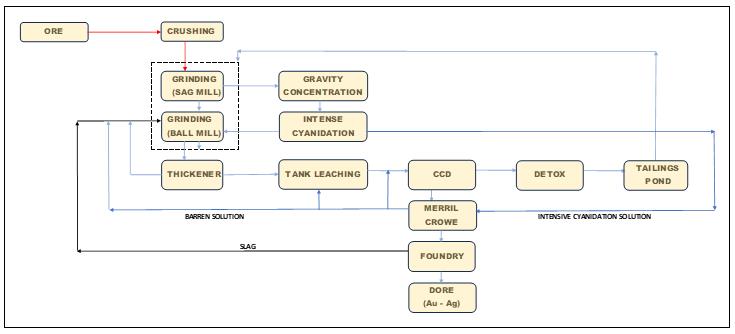
The Diablillos project is expected to have a conventional silver/gold processing plant flowsheet incorporating crushing, grinding, gravity concentration and intense cyanidation circuit, cyanide leaching with oxygen addition, counter current decantation (“CCD”) washing thickeners and Merrill-Crowe precious metal recovery from solution followed by on-site smelting to doré bars. A summary of the processing flow sheet for the Diablillos project is shown below.
Recent Positive Metallurgical Test Results
Oculto Deposit
On October 10, 2023 the Company reported positive results from metallurgical optimization testing on the Oculto deposit. The metallurgical testing was conducted as part of the ongoing Pre-Feasibility Study ("PFS") for Diablillos.
Key takeaways from the PFS-level metallurgical test work include:
Recovery rates at the Oculto deposit are expected to range between 82% - 86% for silver and 84% - 89% for gold.These results represent a significant increase over the average recovery rates of 73.5% for silver and 86% for gold used in the 2022 Preliminary Economic Assessment (“PEA”).
A substantial percentage of the silver and gold at Oculto can be recovered by gravity separation which results in higher recovery rates and lower processing costs.
Importantly, fine grinding is not necessary with the most efficient recoveries achieved at a grind size of 150 microns for both gravity and cyanidation and an optimal retention time of 36 hours.
JAC and Fantasma Deposits
The Company reported positive preliminary metallurgical test results for the new JAC zone on June 01, 2023.
Key Highlights Include:
Overall recoveries at the JAC and Fantasma deposits range between 86% - 93% for silver and 82% - 91% for gold.
A substantial percentage of the silver at JAC can be recovered by gravity separation which increases overall recoveries.
Current testwork confirms that the same process flowsheet can be used to process mineralization from the Oculto, JAC and Fantasma deposits.
Milling tests have shown that 150 microns is the targeted grind size for the leaching of the mineralized material at a retention time of 36 hours.
Overall silver and gold recoveries could likely be increased further by grinding finer and with higher cyanide concentrations. Further metallurgical testwork and trade-off studies are now underway.
Favorable Recovery Rates
At the JAC and Fantasma deposits the silver minerals (chlorargyrite and iodargyrite) are easier to release by grinding, and are more sensitive to cyanide leaching as they occur in argillic alteration, whereas at Oculto they are mostly held more complexly in vuggy silica host rock.
Summary of Metallurgical Testwork Results for JAC and Fantasma Deposits
Target
Silver
Recoveries
Silver
Head Grades
Gold Recoveries
Gold
Head Grades
%
g/t
%
g/t
JAC & FANTASMA
86 - 93
142 - 172
82 - 91
0.11 - 0.17
Testwork on JAC and Fantasma samples showed that gravity separation before cyanide leaching recovers approximately 9% of the silver and 17% of the gold which, when combined with the subsequent cyanide leaching recoveries, results in total overall recoveries of between 86% and 93% for silver and between 82% and 91% for gold.
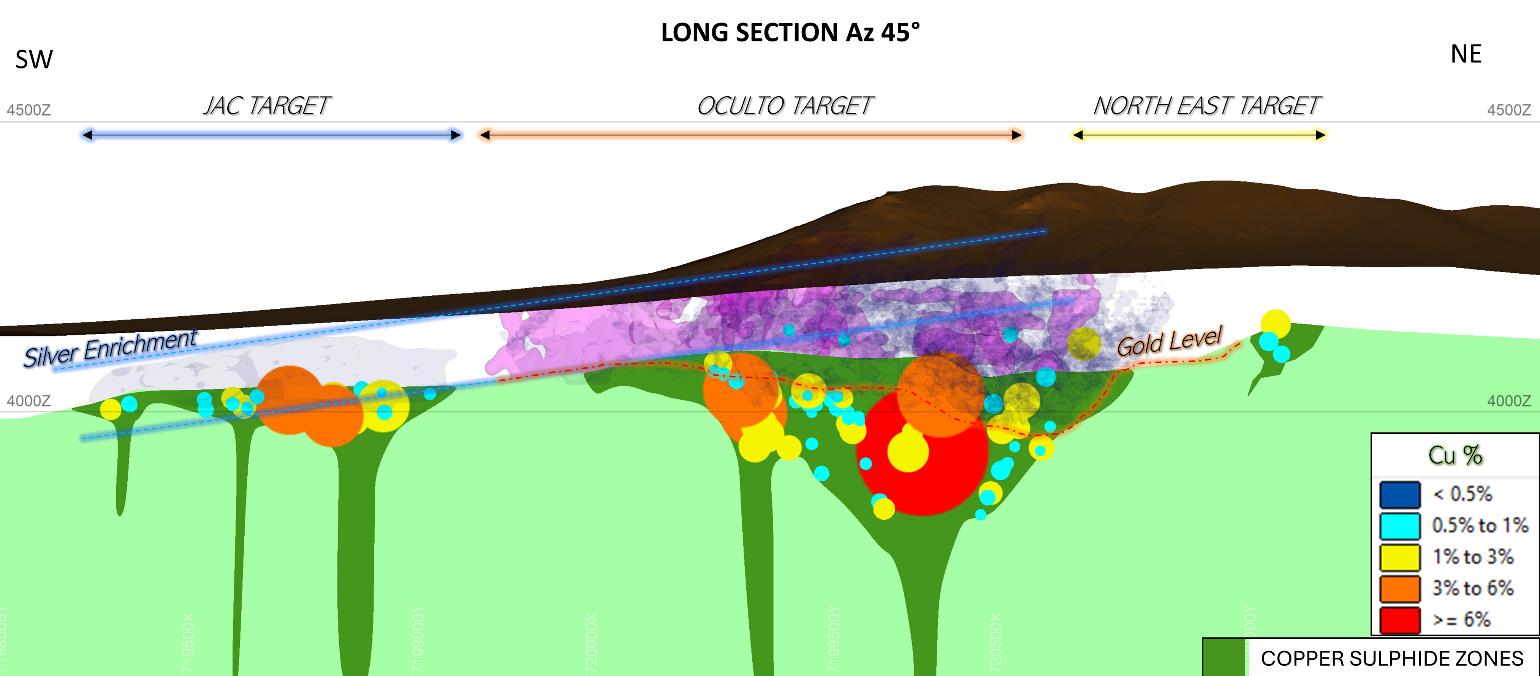
The Diablillos property hosts several zones of high-sulphidation epithermal alteration and mineralization with strong supergene overprinting. There are several known mineralized zones on the Diablillos property, with the Oculto zone hosting the principal silver-gold deposit. Oculto is strongly oxidized down to depths in the order of 300 m to 400 m from surface with oxide gold and silver mineralization overlying a pronounced copper sulphide zone extending beneath. The sulphide mineralization has an enriched copper layer with chalcocite coating chalcopyrite and pyrite, with associated variably high grades of gold and silver. Primary copper sulphide mineralisation extends to considerable depths towards the base of the mineralised system. The precious metal mineralization throughout the oxide zone of the deposit occurs as extremely fine grains along fractures and in breccias or coating the inside of vugs and weathered cavities. The dimensions of the optimised Whittle open pit shell measure 1,350 metres in length, 750 metres in width and extends to a maximum depth of approximately 300 metres.
Gold and silver mineralization ascended along steeply dipping feeder structures and was deposited in siliceous breccia zones. Mineralizing fluids also migrated laterally along shallowly dipping favorable permeability horizons where it was deposited along with silicification. Gold is associated with a deeper permeability horizon and with shallow zones associated with the feeder structures, while there is a secondary enriched silver zone related to a weathered horizon.
Diablillos Geological Model: Near-Surface Epithermal Ag-Au Deposit, With Cu-Au Porphyry Intrusive at Depth
The Table below highlights reported drill intercepts in sulphide mineralization, from the limited amount of deeper drilling conducted at Diablillos to date.
Highlights of Selected High-Grade Intercepts in Sulphide Minerlization at Diablillos
Drill Hole
From
(m)
To
(m)
Interval
(m)
Cu
(%)
Au
(g/t)
Ag (g/t)
DDH-19-002
369
401
32
1.26
2.20
24.6
DDH-19-002
438
446
8
2.11
0.47
32.7
DDH-20-001
268
271
3
1.06
3.45
339.1
DDH-20-001
275
303
28
3.25
1.60
358.3
DDH-20-002
337
349
12
1.74
1.14
12.3
DDH-20-003
446
446.5
0.5
6.37
0.56
12.3
DDH-20-006A
293
315.5
22.5
0.52
0.35
9.45
DDH-20-007
265
270
5
1.54
0.03
98.5
DDH-20-007
376
377
1
1.22
2.34
51.6
DDH-20-008
350
361
11
1.58
1.27
12.7
DDH-20-010A
313.5
320.5
7
0.99
2.18
17.8
DDH-20-019
146
173
27
1.37
0.20
31.0
DDH-21-009
311
316
5
0.90
2.14
10.3
DDH-21-009
354
356
2
0.66
1.73
37.7
DDH-21-020
302.5
324
21.5
1.76
-
-
DDH-21-024
275
287
12
1.40
2.98
26.8
DDH-21-040
272
277
5
4.20
3.22
49.5
DDH-22-021
368.5
379.5
11
2.00
0.30
5.49
DDH-22-043
215
227
12
3.63
0.29
3,664.9
DDH-22-067
185
195
10
2.55
0.73
590.3
DDH-22-067
197
206
9
0.75
1.25
534.4
DDH-22-078
181
198.5
17.5
1.54
0.01
25.5
DDH-22-083
162.5
171
8.5
3.36
0.10
694.7
DDH-22-086
158
172
14
1.18
-
-
DDH-23-009
169.5
183
13.5
0.64
0.06
184.9
DDH-23-025
179
212.5
33.5
3.03
0.01
88.5
DDH-23-046
157
160
3
1.11
0.27
2,070.0
DDH-23-062
155
163
8
1.04
0.01
60.7
Note: All results are rounded. Assays are uncut and undiluted. Widths are drilled widths, not true widths. True widths are estimated to be approximately 80% of the interval widths.
Over 170,000 meters of drilling has been completed at Diablillos to date, supporting the rapid growth of the Project into one of the world's largest undeveloped primary silver resources.
Year
Operator
Description
1983
Secretaría de Minería de la Nación
1,409 rock chip samples (includes 190 outcrop and 271 slope debris samples from Diablillos Sur)
1984 - 1987
Shell C.A.R.S
A Rock geochemical survey; three Winkie drill holes
1987
Ophir Partnership
37 rotary drill holes (approximately 30 m deep) in the Corderos, Pedernales, Laderas, and Jasperoide areas
1989 - 1991
BHP
Geological mapping (1:1,000 to 1:7,500 scale); 380 rock chip samples; 1,200 m of bulldozer trenches; 55 air RC holes (6,833 m)
1993
Pacific Rim Mining Corporation
Five diamond drill holes (1,001.8 m) in the Oculto Zone
1994
Pacific Rim Mining Corporation
148 km of chain and compass grid; geological mapping; 122 line-km of ground magnetic survey; 34 line-km of induced polarization (IP) survey; 213 hand auger samples; 2.5 km of trenching; 250+ rock chip samples; 12 diamond drill holes (2,013.9 m)
1996 - 1997
Barrick Gold Corp
Geological mapping; surface sampling; RC drilling; CSAMT survey; mag survey; environmental impact study; metallurgical test work
2003
Pacific Rim Mining Corporation
(for Silver Standard)
20 diamond drill holes (3,046 m)
2005
Pacific Rim Mining Corporation
(for Silver Standard)
Five diamond drill holes each at Renacuajo and Alpaca
2007
Pacific Rim Mining Corporation
(for Silver Standard)
45 diamond drill holes (9,600 m) on Oculto; one hole (203 m) at Laderos; three holes (unknown length) at Pedernales; five holes (unknown length) at Los Corderos; four HQ-size diamond drill holes sampled for metallurgical tests
2008
Pacific Rim Mining Corporation
(for Silver Standard)
52 diamond drill holes (7,910 m), three of these for geotechnical studies; additional metallurgical studies
2009
Silver Standard Resources
Mineral Resource estimate
2011 - 2012
Silver Standard Resources
Internal Preliminary Economic Assessment, rock chip sampling, 1,679 m diamond drilling (19 holes)
2017
AbraSilver
28 drillholes and a total of 3,148.5m
2018
AbraSilver
Preliminary Economic Asessment including Resource estimate
2019
AbraSilver
Phase I Drilling Campaign with 2 diamond drill holes (844 m),
2020 - 2021
AbraSilver
Phase II Drilling Campaign of 55 drillholes and a total of 15,143 m expanding Oculto to North, West and East and testing new targets
2022 - 2023
AbraSilver
Phase III Drilling Campaign completed totalling over 24,000 m, resulting in the discovery of the new high-grade JAC deposit for which a maiden resource was announced in November 2023
2024
AbraSilver
Completed the Phase IV drill program focused on expanding and upgrading mineralization at the Oculto and JAC deposits, while continuing to demonstrate strong exploration upside across the broader Diablillos district
2025
AbraSilver
Completed the Phase V drill campaign, which further expanded high-grade mineralization at Oculto and other key target areas. All drill results from this program were incorporated into the updated Mineral Resource Estimate announced in May 2026, which outlined substantial growth across both the tank leach and heap leach component of the Project.
2026
AbraSilver
The ongoing fully-funded Phase VI drill program is underway to further expand and upgrade Mineral Resources across multiple target areas at Diablillos. Results to date continue to highlight the significant exploration upside and long-term growth potential of the Project.
Scroll right to view more
Scroll right to view more
Scroll right to view more
Scroll right to view more
Subscribe to our Newsletter
I agree to and consent to receive news, updates, and other communications by way of commercial electronic messages (including email) from AbraSilver Resource Corp.
I understand I may withdraw consent at any time by clicking the unsubscribe link contained in all emails from AbraSilver Resource Corp.
AbraSilver Resource Corp
220 Bay St, Suite 550
Toronto, ON M5J 2W4 [email protected]